

LABEL ADHESIVES COMPARISON GUIDEChoose the best adhesive for glass, PET, HDPE & More
How to Choose the Right Adhesive for Your Surface & Environment
Choosing the right label material is important — but choosing the right adhesive is critical.
Adhesive determines whether your label stays secure, lifts at the edges, leaves residue, or fails entirely. The right choice depends on surface type, temperature, environment, and how long the label needs to perform.
We brought together the combined expertise of our production team and label specialists to create this guide that compares common label adhesive types and explains how to select the best option for your specific application.
WHAT DOES "ADHESIVE" ACTUALLY MEAN FOR LABELS?
In a pressure-sensitive label, the adhesive is the bonding layer that attaches the facestock (paper, BOPP, PET, etc.) to the surface of your product or packaging.
Now, let’s get into the details that really count!
When evaluating adhesives, three performance factors matter most:
- Initial Tack – How quickly the label bonds upon application
- Peel Strength – How resistant the label is to being pulled off
- Shear Strength – How well the label resists sliding or lifting over time
No single adhesive excels in every category. The best choice depends on where and how the label will be used.
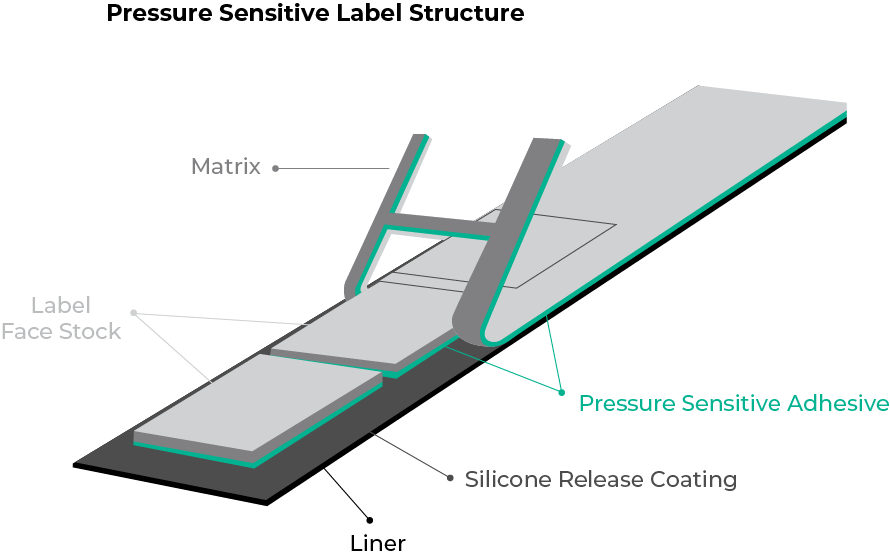
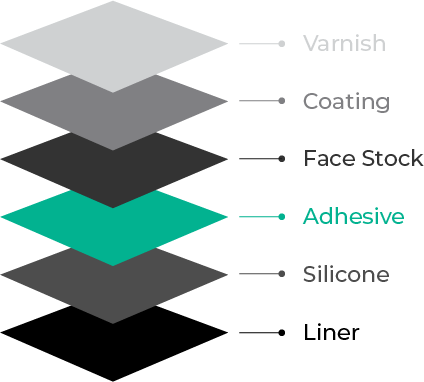
FIRST, LET'S TALK COMMON ADHESIVE MISCONCEPTIONS
There are a few things that tend to sound right, but end up in label nightmares—don't worry, though, we'll cover all the main ones here, and then go over how to match your label adhesive with your intended use further down.
1. "Stronger is always better."
Sometimes, but not always. Overly aggressive adhesives can damage surfaces, leave residue, or impact sustainability considerations.
2. "All permanent adhesives perform the same."
They do in the sense that they're permanent, but they vary significantly depending on formulation and intended use. "Permanent" in one environment doesn't necessarily mean "permanent in all environments".
3. "Cold automatically causes label failure."
Cold environments cause label failure only when incorrect adhesives or label stocks are chosen—they don't have to cause failure, but they can.
4. "If it sticks at first, it's fine."
Initial tack doesn't guarantee long-term shear performance. Below, we'll get into the details of what does impact long-term performance.
Common Types of Label Adhesives
PERMANENT ADHESIVES
Best for: Long-term labeling, general packaging, indoor applications
Permanent adhesives are designed to remain in place for the life of the product. Once applied, they are not intended to be removed cleanly.
ADVANTAGES
Strong, reliable bondGood performance across many surfaces
Suitable for most general packaging applications
CONSIDERATIONS
May leave residue if removed
Not ideal for temporary or reusable containers
FREEZER & COLD TEMPERATURE ADHESIVES
Best for: Refrigerated and frozen goods.
Cold environments change how adhesives behave. Standard adhesives may lose tack or become brittle at low temperatures, but specialty adhesives are designed to perform in exactly those conditions.
Freezer-grade adhesives are formulated to:
Apply in cold conditions
Maintain bond strength in refrigerated or frozen storage
Resist condensation
Important: Surface preparation and application temperature matter as much as storage temperature.
HIGH-TACK ADHESIVES
Best for: Rough, textured, or low-surface-energy mterials.
Some plastics (like HDPE or LDPE), corrugate, and uneven surfaces require more aggressive adhesion.
ADVANTAGES:
Improve bonding to challenging materials
Compensate for surface irregularities
CONSIDERATIONS:
May be difficult to remove
Can increase material cost
Must be matched carefully to avoid over-adhesion
SPECIALTY & CHEMICAL-RESISTANT ADHESIVES
Best for: Industrial, chemical, or high-exposure environments.
Some environments laugh right at standard adhesives because they have a unique set of conditions that require special adhesive formulations for performance.
What kind of environments require specialty adhesives?
When labels are exposed to oils, solvents, abrasion, or outdoor environments, specialty adhesives may be required.
These are typically paired with durable facestocks like polyester (PET) to ensure long-term readability and performance.
HOW TO CHOOSE THE RIGHT LABEL ADHESIVE
Adhesive selection isn't always about choosing the “strongest” option. It’s about choosing the most appropriate adhesive for your conditions.
Below are the primary decision factors.
1. SURFACE TYPE
Different surfaces have different surface energy, which affects how well adhesives bond.
High surface energy materials (easier adhesion):
- Glass
- Metal
- PET
Low surface energy materials (more challenging):
- HDPE
- LDPE
- Some coated or textured plastics
Note: If labeling low-energy plastics, a high-tack adhesive is often necessary.
2. LABEL LIFE CYCLE
How long does your label need to remain intact?
- Short-term (days or weeks)
- Medium-term (months)
- Long-term (years)
Permanent adhesives are typically selected for longer durations, while removable adhesives support short-term use.
A note on sustainability:
Another consideration is whether your packaging needs to be recyclable or compostable—not all adhesives are sustainable, and choosing one that can't be recycled or composted can mean that your product packaging can't be, either.
3. ENVIRONMENTAL CONDITIONS
Environmental stress is one of the most common causes of label failures, so it pays to think ahead.
Ask:
- Will the product be refrigerated?
- Will it experience condensation?
- Is it exposed to outdoor UV?
- Will it face abrasion or chemical exposure?
Cold, humidity, and temperature cycling all affect adhesive performance differently.
4. APPLICATION v. SERVICE TEMPS
These might sound the same, but there are big differences that can impact what adhesive is the best choice for your product.
- Application temperature — The temperature at which the label is applied
- Service temperature — the temperature the label will experience after
Some adhesives apply best at room temperature but perform best once chilled. Others are designed specifically for cold application.
Ignoring this distinction is a frequent source of problems.
5. REGULATORY & COMPLIANCE REQUIREMENTS
Certain industries may require:
- Food safe adhesives
- Tamper-evident performance
- Chemical resistance
- Durability or traceability
These requirements may influence adhesive selection beyond surface or temperature considerations.
EXAMPLE ADHESIVE PAIRINGS
The table below provides a high-level comparison of common label adhesive types and their typical performance characteristics.
| Adhesive Type | Best For | Common Surfaces | Temperature Performance | Removability | Key Advantages | Key Considerations |
|---|---|---|---|---|---|---|
| Permanent Acrylic | Long-term product labeling, general packaging | Glass, metal, PET, coated paperboard | Performs well across a wide temperature range | Not removable | Strong, reliable bond; versatile | May leave residue if removed |
| Removable Acrylic | Promotional labels, temporary identification | Glass, metal, smooth plastics | Moderate temperature range | Clean removal | Easy peel; minimal residue | Lower holding power |
| Freezer / Cold-Temp | Refrigerated and frozen products | Glass, PET, HDPE | Designed for cold application and storage | Limited removability | Maintains adhesion in cold and condensation | Surface prep critical |
| High-Tack / Aggressive | Rough, textured, low-energy plastics | HDPE, LDPE, corrugate, textured plastics | Moderate to wide range | Difficult to remove | Bonds to challenging surfaces | Can damage surfaces |
| Chemical-Resistant | Industrial, chemical, outdoor use | Metal, plastic, coated containers | Wide range | Not removable | Resists oils, solvents, abrasion | Higher cost |
| Food-Safe Adhesives | Food & beverage packaging | Glass, PET, paperboard | Depends on formulation | Depends on formulation | Meets regulatory requirements | Must be verified per application |

Follow Us